
News & Media Updates
Latest News
- September 2026 Updates
- Spivi Go – The New Mobile App
- Spivi + Les Mills – Now Streaming in Your Studio
- November 2025 updates
- September 2025 Updates
- New Challenge Options Available
- Sensor Pairing Tool has been upgraded!
- July Update – Touchscreen Control and New Integration
- June 2025 Update – New Visuals and More Membership Software Integrations!
- April 2025 Updates
- March 2025 Updates
- December 2024 Updates – Performance Dashboard Additions
- November 2024 Updates – Timers and new Integration
- August 2024 Updates – Spivi Academy, Timers and More
- July 2024 updates – Club vs Club challenges and more!
Spivi on the Media
- The gamification of fitness on BBC Business Daily
- Wellfit launches flagship sports and fitness hub in JVC to encourage active lifestyle
- Cycle Life Studio on WFMJ
- All City Riders is an immersive indoor cycling center
- All City Riders on the Good Day TV show
- Technology innovates indoor cycling studio concept in Natal
- Leading the Pack
- Redefining Physical Education – IASA Podcast
- With Spivi, the indoor cycling experience becomes more than just cycling
- With spin bikes and heart monitors, schools are redefining gym to help kids take ownership of their health
- Five spinning studios to visit in London
- The best spinning classes in London
- 5 Reasons To Train Indoors This Autumn
- Fitness connected: in Toulouse, these studios that make you move differently
- Prazerices: Ride State, the new indoor cycling studio in São Paulo
- Review: Digme Fitness
- Long live Shape Magazine – France
- SPORTV Brazil
- Hot fitness trends emerge in Houston (ABC13 Eyewitness News)
- Fitness Friday – Cycle Loft (WFMY2 News)
- Spivi / la nouvelle facon de faire du biking? (France)
- Le Biking Spivi – Sports Auvergne (France)
- A Competitive Edge – Club Solutions
- Spivi on SPORTV News (TV, Brazil)
- Spivi on Tarn Actu (France)
- Spivi on FOX 26 (Houston, Texas)
- Indoor Cycling classes and Technology
- Spivi on Fox 5 TV News
- Spivi on South Korea national TV news
- Spivi on France TV, Channel 3
More From The Spivi Blog
7 Ways Fitness Technology Improves the Member Experience
- September 2026 Updates
- Spivi Go – The New Mobile App
- Spivi + Les Mills – Now Streaming in Your Studio
- November 2025 updates
- September 2025 Updates
- New Challenge Options Available
- Sensor Pairing Tool has been upgraded!
- July Update – Touchscreen Control and New Integration
- June 2025 Update – New Visuals and More Membership Software Integrations!
- April 2025 Updates
- March 2025 Updates
- December 2024 Updates – Performance Dashboard Additions
- November 2024 Updates – Timers and new Integration
- August 2024 Updates – Spivi Academy, Timers and More
- July 2024 updates – Club vs Club challenges and more!
Spivi on the Media
- The gamification of fitness on BBC Business Daily
- Wellfit launches flagship sports and fitness hub in JVC to encourage active lifestyle
- Cycle Life Studio on WFMJ
- All City Riders is an immersive indoor cycling center
- All City Riders on the Good Day TV show
- Technology innovates indoor cycling studio concept in Natal
- Leading the Pack
- Redefining Physical Education – IASA Podcast
- With Spivi, the indoor cycling experience becomes more than just cycling
- With spin bikes and heart monitors, schools are redefining gym to help kids take ownership of their health
- Five spinning studios to visit in London
- The best spinning classes in London
- 5 Reasons To Train Indoors This Autumn
- Fitness connected: in Toulouse, these studios that make you move differently
- Prazerices: Ride State, the new indoor cycling studio in São Paulo
- Review: Digme Fitness
- Long live Shape Magazine – France
- SPORTV Brazil
- Hot fitness trends emerge in Houston (ABC13 Eyewitness News)
- Fitness Friday – Cycle Loft (WFMY2 News)
- Spivi / la nouvelle facon de faire du biking? (France)
- Le Biking Spivi – Sports Auvergne (France)
- A Competitive Edge – Club Solutions
- Spivi on SPORTV News (TV, Brazil)
- Spivi on Tarn Actu (France)
- Spivi on FOX 26 (Houston, Texas)
- Indoor Cycling classes and Technology
- Spivi on Fox 5 TV News
- Spivi on South Korea national TV news
- Spivi on France TV, Channel 3
More From The Spivi Blog
7 Ways Fitness Technology Improves the Member Experience
The member experience in group fitness is built mostly on what happens during the 45 minutes people are in the room. Good equipment, a strong instructor, a format that keeps people engaged. For a long time, technology barely entered that picture. Over the last few years it started to, and not in the direction most people expected: less about gadgets, more about giving members something concrete to track and giving instructors something real to coach from.
Performance Visibility During Class
The most immediate change technology brings to a group fitness class is visible performance data. When members can see their output on a shared display, the dynamics of the class shift. Effort calibrates against visible benchmarks. Instructors have something real to reference mid-session. Members who might otherwise check out during a hard interval stay engaged because there’s a number on the screen that tells them where they are and where they could push to.
This isn’t purely motivational. The data is also functional: it tells an instructor when the room is coasting and when someone is approaching their limit. Both are worth knowing in real time. Classes that run on visible performance data tend to produce higher average effort levels than ones that run on feel alone, which compounds over months into real fitness gains members can actually see.
Zone-Based Scoring That Includes Everyone
Raw output numbers on a leaderboard have a built-in problem: they favor the already-fit. A seasoned athlete will always outscore a newer member in absolute watts or speed, regardless of how hard each is working. For the majority of participants, that kind of ranking stops being motivating after a few sessions.
Zone-based scoring resolves this by expressing performance as a percentage of each person’s individual capacity. A member working at 85% of their personal maximum scores similarly to a more experienced athlete working at 85% of theirs. The leaderboard reflects effort across the whole room, which turns out to be a much better representation of what actually happened in the class. Facilities that switch from raw output to zone-based scoring reliably see broader screen engagement, and broader engagement correlates with better retention across the board.
Post-Session Summaries in the Member App
The session ends and most members walk out with nothing. Maybe a vague sense of how hard they worked. Certainly no idea how it compared to last week. Most people don’t keep notes on this, and why would they; there’s been nothing to track. Without a record, there’s no specific reason to come back and beat anything.
Automated post-session summaries solve this. The member gets their output data, heart rate summary, zone breakdown, and leaderboard position pushed to their phone. That summary creates a touchpoint between sessions, keeps the program relevant between visits, and gives the member a specific baseline to improve on. Over time, the record of sessions becomes part of why they keep coming back.
Personal Best Tracking
The simplest effective retention tool in group fitness is showing members how they compare to their own previous performance. A member who hit 295 average watts in Tuesday’s class now has a specific number to beat. The target is always relevant because it was set by their own effort.
Personal best tracking creates a form of competition that scales perfectly to every fitness level and that never gets stale. The record keeps updating, so there’s always something to chase. Members with a personal best to beat have a concrete reason to show up on a specific day, and that specificity turns out to be more durable than general motivation to exercise.
Challenges and Community Programming
Technology makes it practical to run ongoing challenges and team-based programming at a scale that would be operationally difficult otherwise. A four-week challenge with a live leaderboard, team scores updating in real time, and automated milestone notifications is a very different experience from a paper-based points system someone has to update manually.
The member experience benefit here is partly about the challenge itself and partly about what it creates around attendance. A member three days into a four-week challenge has social stakes attached to showing up. Missing a session has a cost that goes beyond the session itself. That social pull is one of the more reliable drivers of consistent attendance, and running challenges at any meaningful frequency requires the platform to handle the logistics automatically.
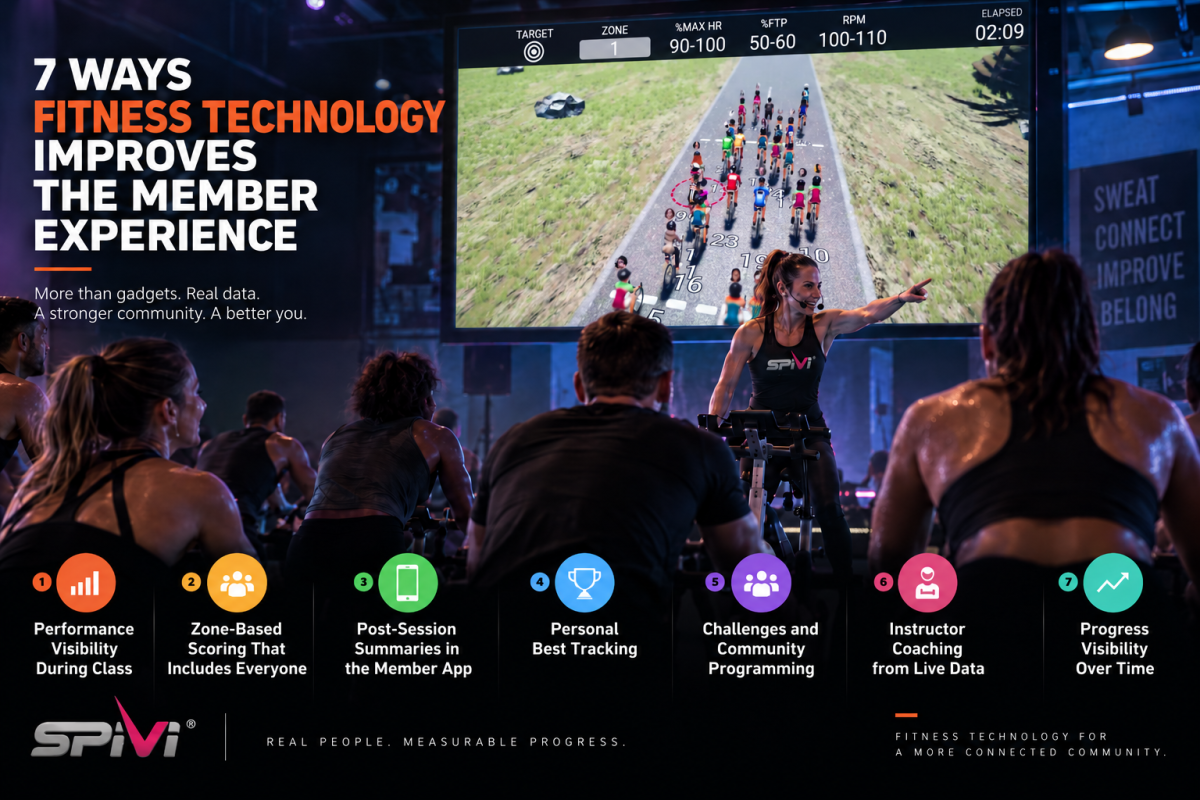
Instructor Coaching from Live Data
An instructor running a class on feel makes educated guesses about the room. An instructor with a live dashboard showing output across every participant responds to what’s actually happening. The experience for members is noticeably different: coaching that references the actual data in the room, that calls out the effort genuinely being shown rather than offering generic encouragement, lands differently and keeps engagement higher through the second half of a class when it’s easiest to lose people.
Getting instructors comfortable working with live data takes a session or two of preparation. Once they’ve done it, most find it genuinely improves the class, because they’re no longer relying on estimation for where the room is at. The member experience downstream of that is a better-coached class.
Progress Visibility Over Time
The member experience extends beyond any individual class. A member who can pull up six months of performance data, see personal bests improving, track consistency patterns, and review past challenge results has a relationship with the program that’s harder to walk away from. The record of progress is itself a reason to continue.
Facilities that give members access to their own longitudinal data tend to see longer average membership tenure and stronger resistance to churn around the second and third month, when novelty has worn off but deep habit hasn’t fully formed yet. Visible progress fills that gap with something concrete.
Where Spivi Fits
Spivi connects the in-class experience to the between-session one across cycling, rowing, and cardio formats. Real-time zone-based displays and instructor dashboards handle the live coaching layer. Post-session summaries push automatically to the member app. Personal bests, challenges, and milestones show up automatically as part of class, so members don’t have to go looking for them. On the operator side, there’s aggregate performance and attendance data that lets you spot a member who’s drifting before they’ve actually gone quiet on the billing side.
Frequently Asked Questions
Do members actually use the app between sessions, or does engagement drop off quickly?
It depends on what the app gives them. An app that only shows the class schedule gets ignored. An app that shows the member their performance summary from yesterday’s class, their current personal bests, and the leaderboard for the challenge they’re in gets opened regularly. The content has to be specific to the member and updated after each session. When it is, between-session engagement tends to be strong particularly in the first 90 days when members are still building their attendance habits.
How do members who aren’t tech-savvy react to performance tracking?
Better than you’d expect, as long as onboarding isn’t over-engineered. During class the display experience is basically passive: numbers show up, members respond to them. There’s no technical burden on the participant. Post-class is where you need to be thoughtful: if the summary lands as a push notification with the data already visible, most people will look at it without having to navigate anywhere. Simple interface, clear numbers. Trying to cram in every metric is where you lose people.
Does fitness technology make the instructor role less important?
The opposite tends to happen. Instructors with live data in front of them typically deliver better-coached classes because their cues and adjustments are grounded in what’s actually happening rather than impressions. The instructor’s read of the room gets sharper, and the class experience improves as a result. Members who experienced a class coached with live data against one coached without it almost universally prefer the former, even when they can’t articulate exactly why.
What’s the minimum viable technology setup for improving the member experience?
A real-time display and a post-session summary pushed to a member app covers the majority of the impact. Zone-based scoring on the display handles the motivation layer; the summary handles the between-session connection. Everything else, challenges, milestones, aggregate reporting, builds on top of that foundation and adds value, but those two elements produce the most immediate change in the member experience and the most direct measurable effect on attendance frequency.
How long before a facility sees measurable changes in attendance after adding performance technology?
Most facilities report visible changes in the four-to-eight-week range, with the clearest signal coming from attendance frequency per active member rather than total headcount. That metric tends to improve first because the change in member experience affects how often existing members come back, before any effect on new member acquisition shows up. The retention improvement at the 90-day mark is typically where the compounding effect becomes clearest in the data.
The Bottom Line
The member experience in group fitness used to plateau at good equipment and a strong instructor. Performance technology has added a layer that changes how engaged members are during class, how connected they feel to the program between sessions, and how long they stay. None of these are trivial improvements, and most facilities that have implemented them find the retention data makes the investment straightforward to justify.
The seven improvements described here aren’t independent. They build on each other: visible in-class data feeds the post-session summary, which reinforces personal bests, which creates stakes for challenges, which sustains attendance through the periods when motivation alone would have let it drift. The member experience improves most when the full loop is running.
Want to see how Spivi brings these elements together across your group fitness formats?
Schedule a Personalized DemoMore From Our Blog
- The Science Behind Gamification: Why Competition Increases Member Motivation
- 15 Proven Ways to Increase Group Fitness Class Attendance
- Why Members Stop Coming to Group Fitness (And How to Keep Them Coming Back)
- The Ultimate Guide to Performance Tracking in Group Fitness
- How to Launch a Successful Indoor Cycling or Treadmill Performance Program


